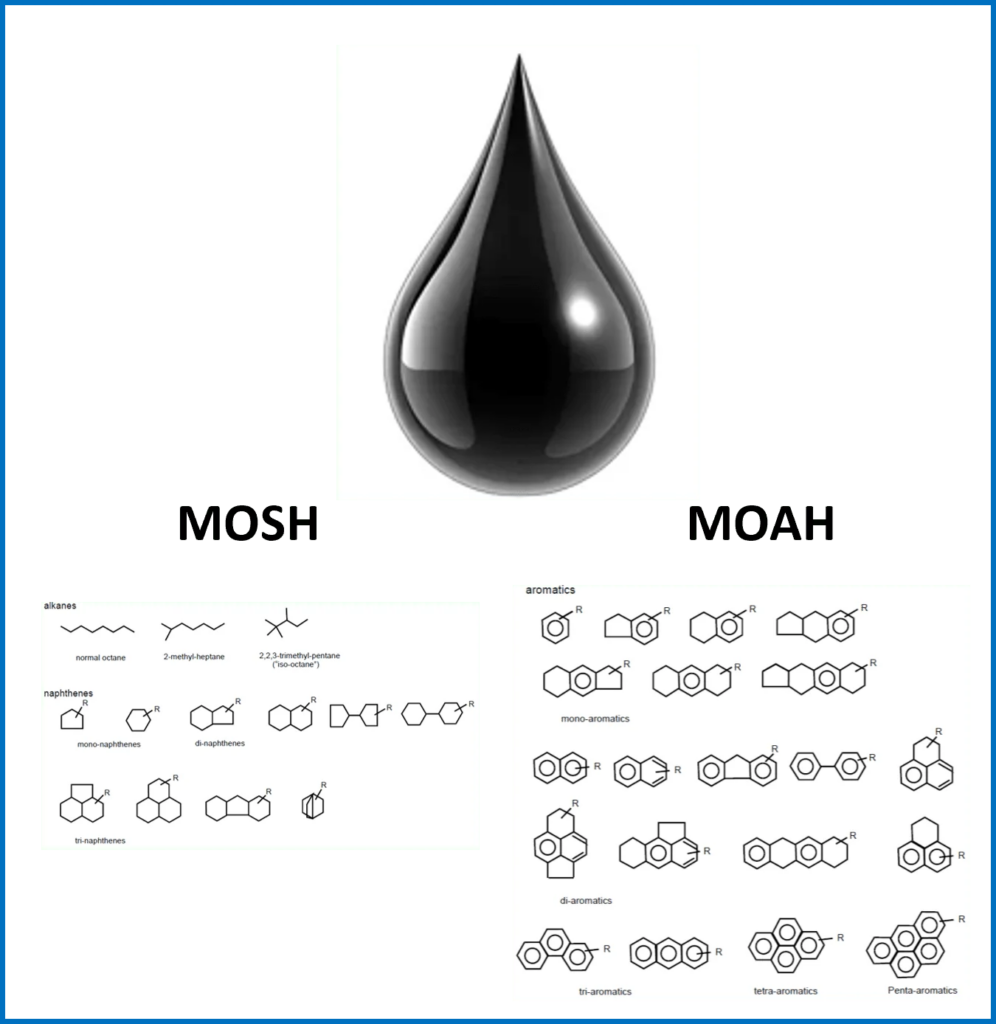
MOSH/MOAH definition
Mineral oil hydrocarbons (MOH) are a complex mixture of chemical compounds derived mainly from the distillation and refining of petroleum, although they can also originate from coal, natural gas, or biomass. Their composition and behavior vary depending on the source and degree of processing of the mineral oil. In the context of MOSH/MOAH analysis, these compounds are divided into two main groups with distinct chemical and toxicological properties:Mineral Oil Saturated Hydrocarbons (MOSH)
- Include open-chain hydrocarbons (mainly branched paraffins) and cyclic hydrocarbons with at least one saturated ring (naphthenes).
- They are chemically stable compounds that can accumulate in fatty tissues and organs such as the liver, spleen, and adipose tissue.
- Although their long-term effects are not yet fully understood, EFSA recommends continuous monitoring due to their bioaccumulative potential.
Mineral Oil Aromatic Hydrocarbons (MOAH)
- Composed of highly alkylated aromatic hydrocarbons containing one or more aromatic rings.
- MOAH with three or more aromatic rings have shown genotoxic and carcinogenic potential, which is why their detection through MOSH/MOAH analysis is a priority in food and food-contact materials.
- MOAH with one or two aromatic rings still present toxicological uncertainty due to a lack of conclusive data on their biological behavior.
Potential Sources of MOSH/MOAH Contamination
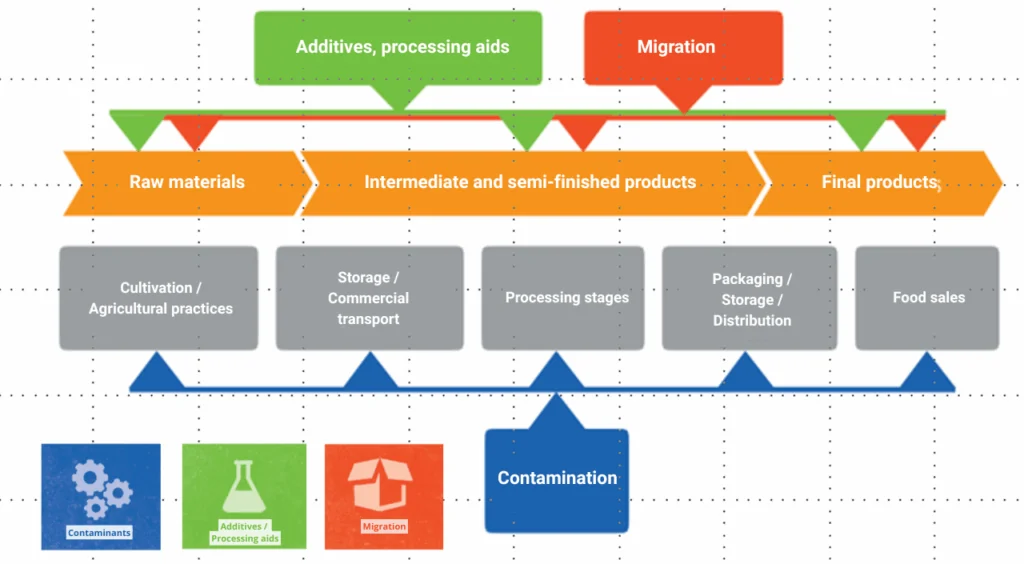
MOSH and MOAH can enter the food chain through multiple routes across the production, processing, and distribution stages. These pathways make their control highly complex and call for a comprehensive prevention strategy. Among the main sources of mineral oil hydrocarbon contamination are:- Food processing: lubricants and oils used in machinery, anti-foaming agents, or wax coatings applied to fruits and vegetables.
- Migration from packaging materials: recycled paper and cardboard, printing inks, water-resistant waxes, or jute sacks treated with mineral oils.
- Environmental contamination: vehicle exhaust gases, tire particles, or contamination of animal feed and aquatic ecosystems.
- Agricultural practices and storage: migration from contaminated soil or materials, transportation in unsuitable containers, or residues from pesticides and veterinary products.
Main Food Categories Affected
Los estudios de la EFSA (2023) y las alertas del sistema RASFF muestran que ciertos alimentos presentan mayor susceptibilidad a la contaminación. Los resultados del análisis MOSH MOAH revelan concentraciones más elevadas en:- Aceites vegetales y grasas, principal fuente de exposición.
- Cereales y productos de panadería.
- Leguminosas, frutos secos, semillas oleaginosas y especias.
- Chocolate y derivados del cacao.
- Productos lácteos, platos preparados y aperitivos fritos.
- Alimentos para lactantes y pescado en conserva.
Challenges in MOSH/MOAH definition
The MOSH/MOAH analysis presents a high degree of technical complexity due to the nature of food matrices and the composition of contaminants. Mineral oil hydrocarbons are mixtures containing hundreds of chemically similar components, which makes their separation and identification particularly difficult. Key analytical challenges include:- Interference from natural compounds such as terpenes, waxes, carotenoids, or POSH (polyolefin oligomeric saturated hydrocarbons), which can lead to overestimations.
- Difficulty in distinguishing MOSH and MOAH of natural, technological, or contaminant origin.
- Lack of unambiguous markers to identify the exact source of contamination.
Tools for MOSH/MOAH Analysis
The most widely used techniques for MOSH/MOAH analysis are