¿Aún no eres una empresa asociada? Asóciate aquí
- Análisis de ciclo de vida. Huella ambiental
- Conservantes y antimicrobianos naturales
- Consultoría en APPCC, BRC, IFS
- Desarrollo de técnicas rápidas de detección (offline)
- Detección rápida de contaminación microbiológica
- Diseño higiénico equipos e instalaciones
- Estudios de diagnóstico y alteración
- Estudios de eficacia viricida, bactericida y fungicida
- Limpieza y desinfección de superficies
- Mejora sanidad vegetal y animal
- Modelos microbiológicos
- Nuevas tecnologías de conservación
- Obtención de extractos naturales funcionales
- Sensores para detección de cuerpos extraños, composición producto
- Servicios de Seguimiento Normativo. LEXAINIA
- Sistemas digitales para la gestión de la seguridad alimentaria
- Alimentos e ingredientes funcionales
- Asesoramiento legal alimentario
- Desarrollo de reformulación de producto
- Diseño de nuevos métodos de elaboración de alimentos
- Extracción de compuestos naturales y principios activos – FSC
- Fermentación de alimentos, biomasa o de precisión
- Obtención de ingredientes protéicos
- Plant based foods
- Probióticos
- Procedimientos Europeos de autorización
- Productos basados en otras proteínas alternativas
- Aprovechamiento de subproductos
- Biofertilizantes y biopesticidas
- Biogás y biometano
- Biorrefinerías
- Depuración de aguas residuales
- Eco-diseño de envases y estudios de reciclabilidad
- Estudio viabilidad plantas de biogás
- Obtención de compuestos de alto valor añadido
- Pérdidas y desperdicio alimentario (food waste)
- Uso eficiente y circular del agua
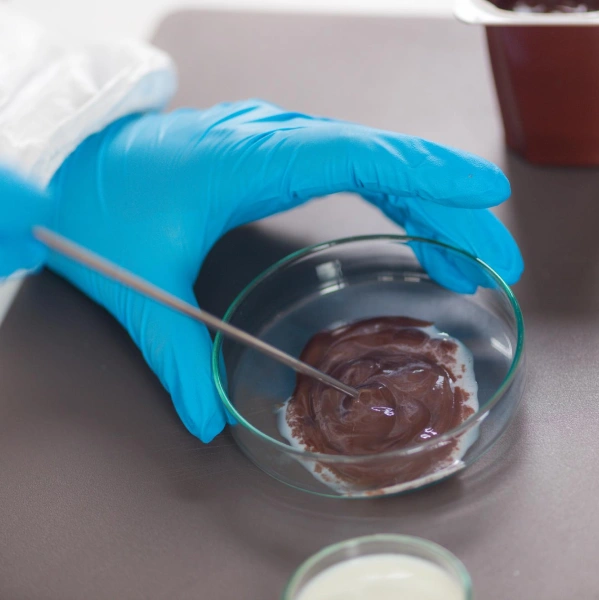
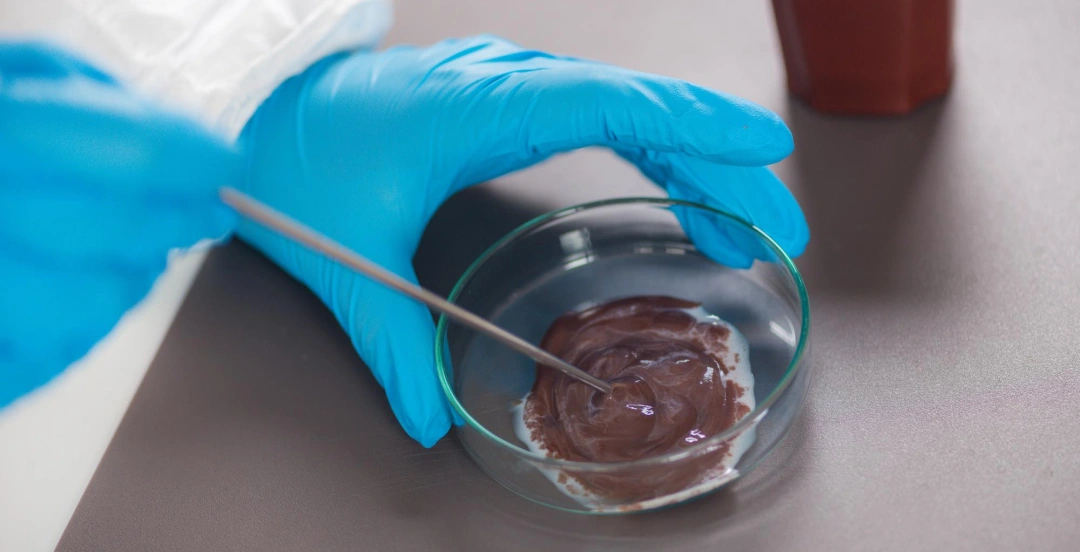

Differential Scanning Calorimetry (DSC)
Differential Scanning Calorimetry (DSC) is a thermal analysis technique that allows the study of how a material responds to controlled heating or cooling, by measuring the heat flow it absorbs or releases during transitions (endothermic and exothermic processes such as melting, crystallisation, glass transition, oxidation or degradation). The information is presented graphically (thermogram), where heat flow is plotted against the temperature range studied.
In the AINIA laboratory, it is used to accurately characterise thermal stability, melting points, crystallisation processes and other relevant events in food and packaging materials, providing essential information for quality control, supplier validation, and product development and optimisation.
Applications
The DSC technique is versatile and can be applied to a wide variety of matrices:
- Evaluation of fat melting, crystallisation and recrystallisation (important in chocolates, margarines, fatty products). Examples:
- Chocolate quality control: from a thermogram (DSC), it is possible to characterise the different polymorphs of cocoa butter. An altered thermal profile can indicate improper tempering, a higher probability of instability and risk of defects (e.g. fat bloom).
- Optimisation of margarines and spreads: by studying fat crystallisation and recrystallisation, DSC helps adjust formulations to achieve stable texture.
- Specific heat analysis
- The technique can be used to estimate heat capacity (Cp), especially through procedures based on modulated DSC (MDSC) to separate reversible/non-reversible components of heat flow.
- Knowing Cp values and their variation with temperature enables modelling of thermal treatments when combined with other parameters such as thermal conductivity, density, etc.
- Determination of melting point (Tm), glass transition temperature (Tg) and degree of crystallinity in polymers. Examples:
- From the thermogram, it is possible to verify whether the material presents Tg and Tm values consistent with the process operating range (hot filling, pasteurisation, etc.) and whether there are transitions close to the use temperature that could compromise dimensional behaviour. This information should be complemented with functional/mechanical testing.
- Measurement of the degree of crystallinity allows verification that the material meets the specifications required for its final use.
- Evaluation of the thermal history of the material. Examples:
- In blow-moulded or injection-moulded packaging, the neck, body and base areas may have different thermal histories and therefore different crystallinity. This enables assessment of processing quality, material uniformity and risk of localised failures.
- Validation of material changes and supplier control. Practical application examples:
- Qualification of new suppliers: comparison of the thermal profile of a new material with the reference material, ensuring that no significant differences exist that could affect the process or product shelf life. The information obtained should be complemented with other techniques (e.g. FTIR, O2TR, etc.).
- With DSC, it is possible to compare key analytical parameters (Tg, Tm, crystallinity and secondary transitions) with a reference material. Detecting significant deviations in these profiles helps identify substitutions or adulterations, considered forms of fraud in packaging materials according to IFS. The study can be complemented with other analytical techniques, FTIR to confirm polymer composition and cross-sectional analysis in multilayer materials, where microscopy allows evaluation of film structure and layer thickness distribution, reinforcing the identification of deviations. The combined use of DSC, FTIR and structural analysis provides a robust tool for mitigating fraud risk in packaging materials, enabling supplier validation, ensuring material compliance and guaranteeing suitability for food contact, complemented by overall and specific migration studies.
AINIA’s competitive advantages
- Comprehensive physical testing services with technical consultancy to select the optimal methodology depending on product and objective (R&D, quality control, process optimisation).
- Agility in developing specific methods.
- Methodologies adaptable to different materials and needs, including specific ramps and tailored experimental conditions.
- Integration into customised analytical plans together with other physicochemical and microbiological services, providing flexible and tailored solutions for each client.

Featured cases
A food company detected that its sauce bottles were losing weight during storage, resulting in actual content being lower than declared on the label. This issue posed a risk of product withdrawal and potential penalties.
To identify the cause, a crystallinity analysis using DSC was carried out, a key technique for evaluating essential packaging properties such as gas barrier, rigidity and stability. The study revealed that the bottles had lower crystallinity than required, due to excessive use of recycled PET material. This lack of crystallinity reduced the packaging barrier and allowed part of the product’s water to escape, causing weight loss.
Thanks to a single analytical test, it was possible to identify the polymer defect and implement a preventive control system based on crystallinity, avoiding future failures and ensuring packaging quality.
Application sectors
Food
Packaging materials
Pharmaceutical
Cosmetic
Biotechnology
Would you like to know more?
Leave us your details and we will contact you to answer your questions or continue the conversation.