Valorization of Agri-food By-products: Functional ingredientes
Large volumes of by-products; such as bagasse, fruit pulps, or peels, and plant-based residues; such as straw, cereal husks, and pruning waste contain significant amounts of cellulose and lignin. However, they have traditionally been considered low-value materials and are often burned, contributing to environmental pollution. Through sustainable processing, this agri-food waste can be transformed into high-value functional ingredients.Selective Fat Removal: Key to Obtaining Healthy and Functional Ingredients
Selective fat removal is a strategic technology applied to plant-based matrices and food industry by-products aimed at developing functional food formulations. At AINIA, supercritical CO? is used to reduce fat content to levels below 1%, while preserving the extraction of natural lipid fractions without the use of organic solvents. This process allows for the creation of low-fat food ingredients suitable for sports or dietetic products, maintaining protein structure and functionality, and eliminating unwanted odors without chemical residues.
Plant-based By-products as a Source of Functional Compounds
Several non-cellulosic fractions present in agrifood waste such as pectins, polyphenols, soluble proteins, and polysaccharides, can be transformed into functional compounds for food and nutraceutical applications. The selective extraction of these bioactive components, followed by the purification of cellulose, leads to the production of ingredients enriched in antioxidants, soluble fiber, or bioactive peptides. Additionally, recovered lignin holds potential for use in antioxidant or antimicrobial formulations.
Biorefineries for Micro and Nanocellulose from Agro-Food Waste
When discussing the reuse of by-products and agri-food waste, it is essential to highlight the role of biorefineries. The agri-food industry generates vast volumes of residues and by-products during food processing operations or agricultural activities. On the agricultural side, these include rice, barley, wheat, and oat straw; corn stalks; rice husks; nutshells and skins; pruning residues; and green waste from greenhouses, among others. These materials often hold little to no economic valueat best, they are used for animal feed, and at worst, they are burned in an uncontrolled manner, contributing significantly to pollution.
Other processed residues, such as brewers’ spent grain, citrus peels and pulp, sugar beet residues, and general fruit and vegetable waste, also represent a serious challenge for the processing industry. What all of these agri-food waste materials share is a high lignocellulosic contentthat is, they are primarily composed of cellulose and lignin.
How to Valorize Agro-Food Waste?
The key lies in the proper extraction of non-cellulosic components, mainly pectins, proteins, and other extracts, and/or in the delignification of the raw material, depending on the chemical composition of each by-product. This is followed by the purification of the cellulose. On one hand, this allows for a high-purity cellulose to be obtained; on the other, it enables the recovery of lignin and other valuable compounds such as bioactives or polyphenols.
At AINIA, we are developing environmentally friendly extraction and purification processes tailored to the nature of each residue, ensuring no harmful waste is generated.
Micro and Nanocellulose: A Hidden Treasure of the Agro-Food Industry
The term “micro and nanocellulose” includes both microfibrillated cellulose (MNFC) and cellulose nanocrystals (CNC). MNFC consists of long, flexible fibers with both amorphous and crystalline regions, while CNCs are shorter, rigid structures lacking the amorphous component.
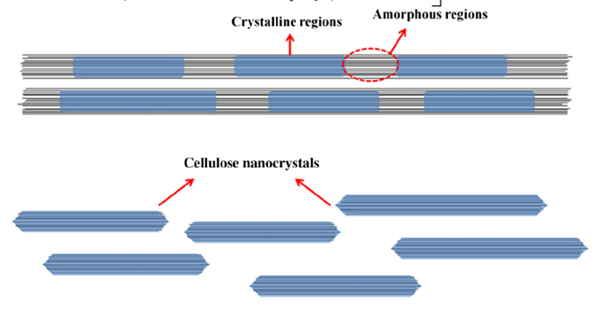
Figura 2. Estructura microfibras de celulosa y nanocristales de celulosa. Fuente: Alle et al. 2020.
Packaging and Biomaterials: Developing New Biodegradable and Compostable Coatings
There is a growing demand in the packaging industry for alternatives to conventional plasticsmaterials that are fully biodegradable and compostable. At AINIA, we are developing new coatings based on modified MNFCs with enhanced hydrophobic properties and improved barriers to oxygen and fats.
-
Bulk application (on cellulose-based packaging): When applied to molded cellulose or paper packaging, MNFCs act as a reinforcing agent, improving the mechanical properties of the final product.
-
Bulk or filler use (with other biopolymers such as PLA or PHAs): This helps improve the overall performance of final products and reduces the amount of raw material requirednot only for food packaging but also for biocomposites in a wide range of industrial sectors.
MNFC as a Biodegradable Coating for Microcapsules
One of AINIAs goals is to identify natural alternatives to synthetic materials for microencapsulation. For this reason, we are using MNFCand, more broadly, micro and nanocelluloseas biodegradable coating agents in the production of microcapsules.
MNFC in Cosmetics: Moisturizing, Emulsifying, and Rheology-Modifying Agent
One of the unique properties of MNFC is its ability to form viscous gels even at low concentrations (13%) in aqueous suspensions. This makes it an excellent rheology modifier. Additionally, market opportunities in the cosmetics sector include its use as a hydrating agent and emulsifier.
This initiative is funded by IVACE (Valencian Institute for Business Competitiveness) under its collaboration agreement with AINIA to support R&D&I activities with industrial transfer potential.