What Is Green Chemistry?
Green chemistry is an innovative approach within chemical science that aims to design products and processes that reduce or eliminate the use and generation of hazardous substances for both the environment and human health. Its goal is clear: to minimise the environmental impact of chemical processes, reduce waste generation, and promote the use of safe and renewable raw materials. The 12 principles of green chemistry can be applied across multiple sectors such as food, cosmetics, agriculture, and the chemical industry. They provide the foundation for the development of cleaner technologies and contribute to the transition towards a circular and low-carbon economy.
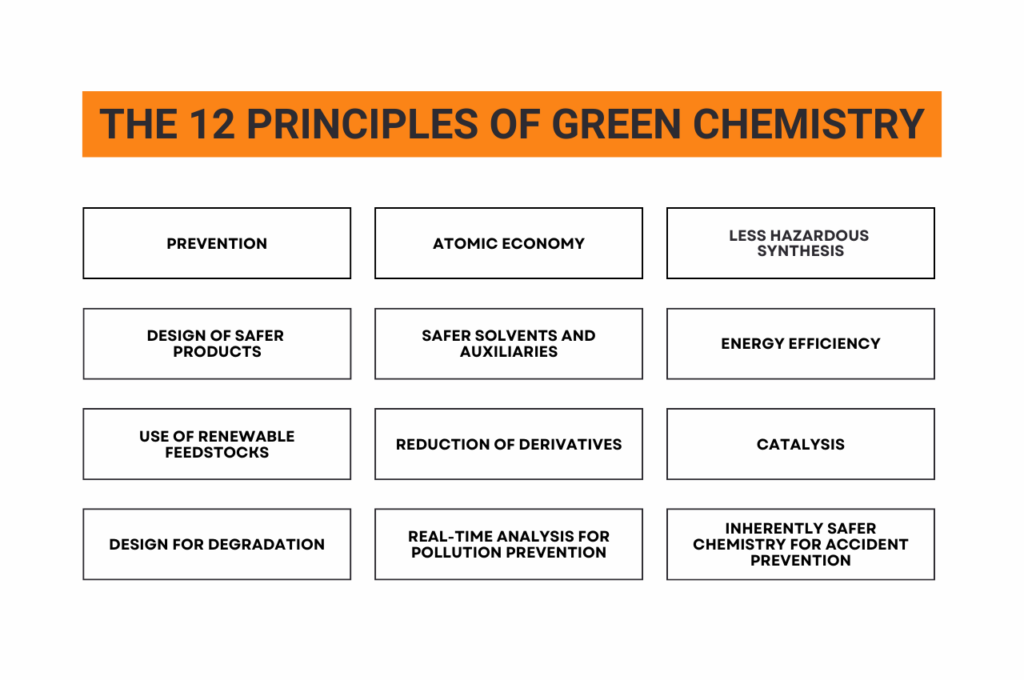
The 12 Principles of Green Chemistry
Formulated by Paul Anastas and John Warner, the 12 principles of green chemistry serve as a framework for designing environmentally friendly processes and products. These principles promote efficiency, safety, and sustainability by seeking to reduce or eliminate the use and generation of hazardous substances from the earliest stages of design.- Prevention: It is better to prevent waste than to treat or clean up waste after it has been created.
- Atom economy: Maximise the incorporation of all materials used in the process into the final product.
- Less hazardous chemical syntheses: Use methods that generate compounds with lower toxicity.
- Designing safer chemicals: Develop products that fulfil their intended function with minimal toxicity.
- Safer solvents and auxiliaries: Reduce or eliminate the use of hazardous solvents or auxiliaries.
- Energy efficiency: Design processes that require minimal energy input.
- Use of renewable feedstocks: Prioritise the use of renewable resources over finite ones.
- Reduce derivatives: Minimise the use of protection and deprotection steps in chemical processes.
- Catalysis: Prefer selective catalytic reagents over stoichiometric ones.
- Design for degradation: Create products that break down into harmless substances after use.
- Real-time analysis for pollution prevention: Develop monitoring methods to control processes and prevent the formation of microcontaminants.
- Inherently safer chemistry for accident prevention: Minimise the potential for explosions, fires, or hazardous emissions.