1. Applying weight-of-evidence approaches
The weight-of-evidence approach makes it possible to build robust scientific dossiers without resorting to animal testing.- Combining complementary data: Integration of results from in vitro assays, in chemico approaches and computational models.
- In silico predictive models: Use of QSAR, machine learning algorithms and simulations to anticipate toxicity, absorption and metabolism. Although their potential is high, these approaches are still undergoing validation.
- Structured documentation: Preparation of coherent reports that facilitate assessment by regulatory bodies such as the SCCS.
2. Digitalisation and automation of testing
Digitalisation is a key accelerator in animal-free testing programmes.- High-throughput screening: Automated platforms that enable multiple formulations to be assessed in parallel, reducing time and experimental error.
- Advanced data management: Implementation of LIMS (Laboratory Information Management Systems) to ensure traceability, data integrity and efficient data exploitation.
- Artificial intelligence applied to analysis: Use of algorithms to identify patterns in large datasets and optimise decision-making in R&D.
3. Active market listening and consumer insights
Cosmetic validation is not limited to the laboratory; it must align with market expectations.- Mapping emerging trends: Analysis of industry reports, scientific literature, patents, retail and digital signals to anticipate trends such as skinification, longevity, the microbiome, clean beauty, sensoriality or sustainability.
- Translating into product requirements: Turning these signals into actionable insights that guide prototype design, the validation plan and the communication strategy.
4. Consumer studies
Consumer studies strengthen technical validation from the perspective of acceptance and real-world use.- Sensory testing and hedonic studies: Assessment of acceptance, preferences, concept fit, emotional impact and purchase intention.
- Translating perception into design decisions: Integration of sensory and emotional outcomes into clear requirements for formulation, packaging and communication.
- Agile execution in real-life contexts (CLT & HUT): Product and consumer tests that enable formulation categorisation, validation and selection with fast, reliable feedback.
- Validation of sensory claims: Design of targeted studies to substantiate on-pack and communication messages, strengthening product credibility.
5. Advanced cellular models applied to animal-free testing
In recent years, the scientific community has consolidated methodologies that fully or partially replace traditional cosmetic testing. These strategies are based on human cellular models and integrate in vitro, in chemico and computational data to generate more predictive assessments. At AINIA, these methodologies are applied both in topical cosmetics and in nutricosmetics, where it is possible to assess bioaccessibility, bioavailability and efficacy of bioactive compounds using advanced in vitro models. Download our Nutricosmetics Validation Guide to explore a practical framework and checklist to build robust scientific evidence.3D reconstructed skin models
What it is Stratified in vitro skin tissues (epidermis or epidermis + dermis with fibroblasts). What it is used for- Safety: irritation, corrosion, permeation and absorption.
- Efficacy: barrier restoration, hydration, anti-ageing action, depigmentation and anti-inflammatory effect.
- Barrier function: TEER, simulated TEWL, permeation rate.
- Inflammation biomarkers: IL-1?, IL-6, IL-8.
- Collagen markers: MMP-1, MMP-3, TGF-?, collagen I/III.
- Barrier proteins: filaggrin, involucrin.
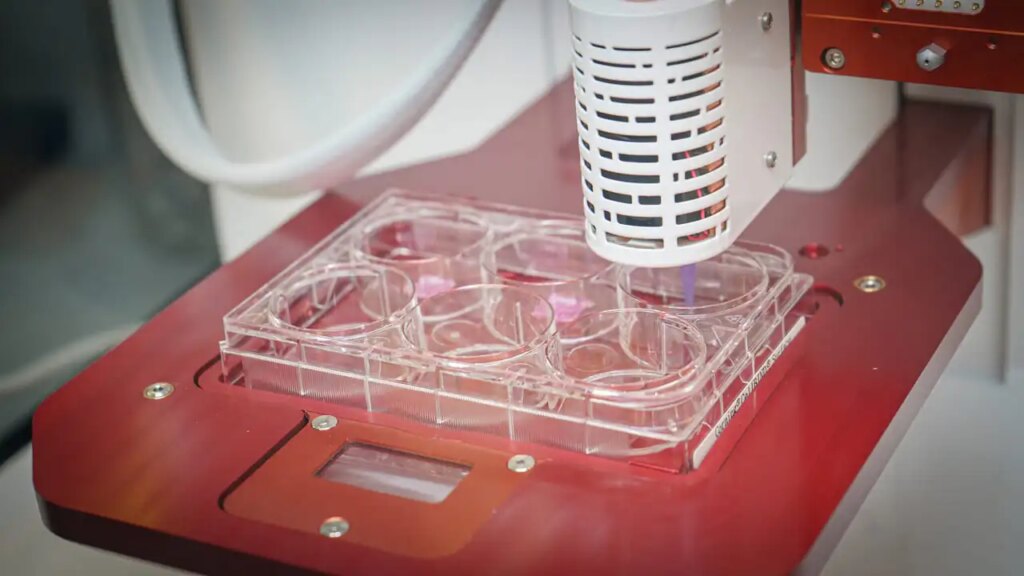
3D bioprinting
What it is Additive manufacturing of dermalepidermal constructs using bio-inks (keratinocytes, fibroblasts ± melanocytes) and matrices such as collagen or GelMA. What it is used for- Designing customised architectures.
- Studying microstructure, wound healing and pigmentation.
- Targeted delivery of actives.
- Compatibility with nano- or micro-encapsulated carriers.
Conclusion: towards faster, more ethical and more predictive cosmetic validation
Animal-free testing approaches provide a solid basis for regulatory compliance and represent a structural shift towards more ethical, sustainable and scientifically robust evaluation models. Moreover, from a strategic perspective, they open the door to advanced technologies such as 3D bioprinting, capable of reproducing the functional complexity of human skin and assessing key parameters such as hydration, regeneration, collagen synthesis or pigmentation modulation. Funded by the aid program for hiring young professionals specialized in internationalization