During the congress, held this week in Valencia and gathering more than 2,000 international experts, AINIAs Director of Innovation, Andrés Pascual, outlined the centres role as a key player in driving a technology-based bioeconomy and generating new opportunities in Spain and across Europe. He also emphasized AINIAs strong track record in technological projects for the sustainable transformation of biomass into a wide range of bioproducts, including food and feed, bioplastics, biomaterials, biofertilizers, biopesticides, bioenergy, and other bio-based products, under a biorefinery model.
In his presentation, Andrés Pascual explained how AINIA leverages scientific knowledge into technological solutions that enable companies using renewable biological resources to move toward more efficient and circular use, and to develop innovative new bio-based products.
Active role in European bioeconomy projects in 2025
At the European level, AINIA actively collaborates with companies and institutions in the most competitive research and innovation programmes in bioeconomy. Between 2021 and 2024, AINIA secured approval for more than 10 projects funded under programmes such as Horizon Europe, LIFE, Circular Bioeconomy, PRIMA, and I3.AINIA has led and participated in numerous European projects in the field. For example, AGRO4AGRI, focused on advanced and sustainable use of agrochemicals for sustainable agriculture; and BREADCRUMB, which seeks solutions to reduce food waste from suboptimal food products. In addition, AINIA is involved in NUTRITIVE, a project developing tools to define sustainable manure management strategies in livestock farming.
In the field of crop protection, the CITRUSBUSTERS project focuses on biological control of the most destructive pests affecting citrus crops. ToBeReal provides technical, business, regulatory, and social support to bioeconomy projects, while GIANTS promotes sustainable growth through collaboration between primary producers and other stakeholders in the value chain. The SATISPHACTION project is developing new sustainable food packaging materials based on PHAs. Other notable initiatives include CHEERS, which transforms brewery industry waste into bioproducts such as proteins, biocides, or cosmetic ingredients; and GLEANSMART, which reduces fruit losses in the field using vision and artificial intelligence technologies. AINIA also participates in MIX MATTERS, a project focused on the valorization of mixed bio-based waste from wholesale markets, greenhouses, and the food industry, through processes that generate new sustainable products. The bioeconomy offers us the opportunity to create value from renewable resources, reduce environmental impact, and stimulate technological entrepreneurship, emphasized Andrés Pascual. In this context, he highlighted StartBEC, an initiative co-funded by the Spanish Ministry of Agriculture, Fisheries and Food, aimed at supporting technology-based startups developing bioproduct-focused projects.Three posters showcased technological innovations
As part of the EUBCE 2025 conference, AINIA also presented three posters featuring significant results on technological innovations applied to biomass valorization. These contributions highlighted the scope of the solutions AINIA is developing in the field of circular bioeconomy.
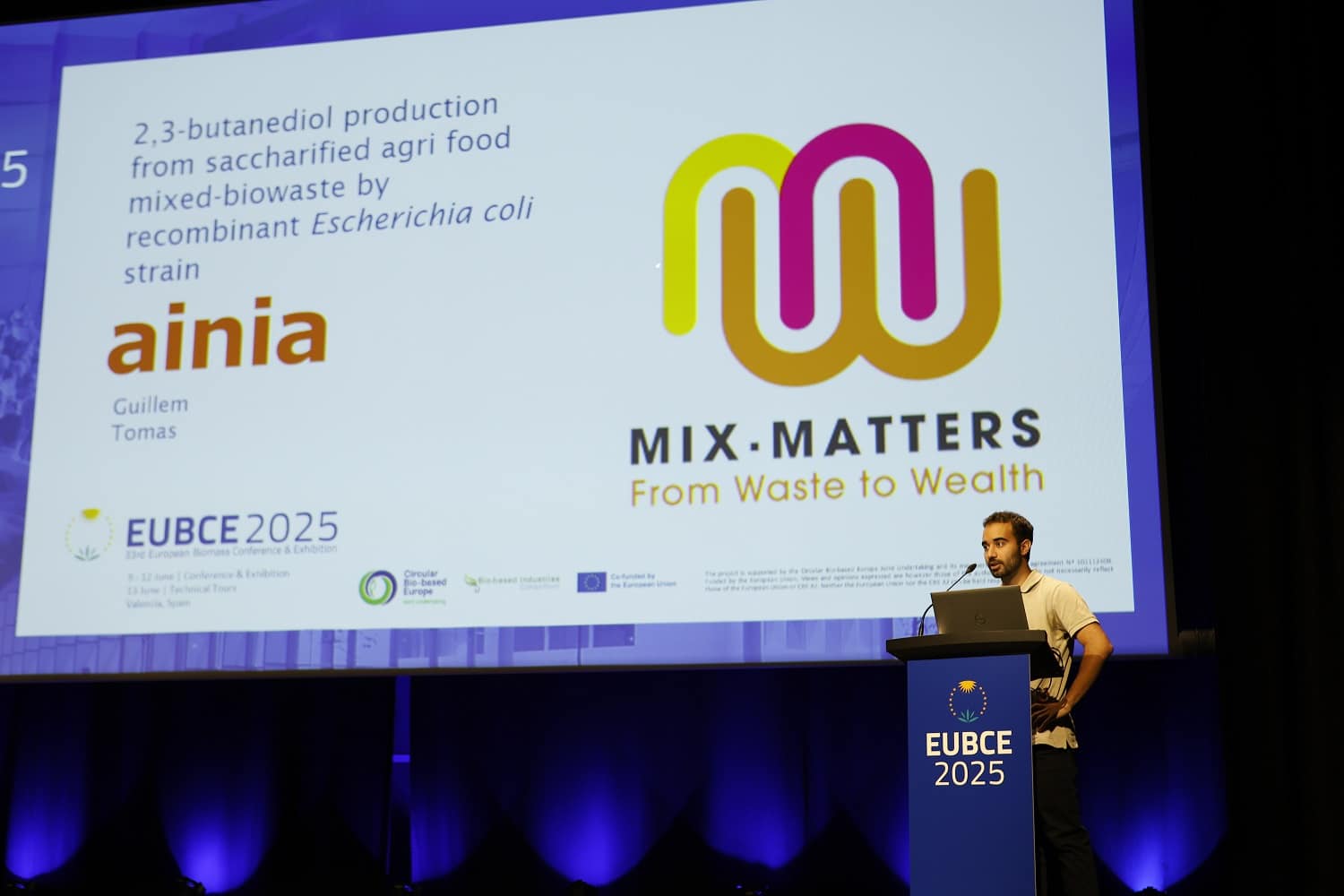
Specifically, Carolina Colvée (Industrial Biotechnology, AINIA) shared results from the CHEERS project, focused on microbial conversion of residual methane into high-quality single-cell proteins (SCP) for animal feed. Guillem Tomás (Industrial Biotechnology, AINIA) presented a study on the production of 2,3-butanediol from agri-food waste using recombinant strains of Escherichia coli. And Gema Arjona (Biomass and Bioenergy, AINIA) presented research on the anaerobic monodigestion of alperujo (olive oil by-product), where AINIA developed strategies to overcome polyphenol inhibition and valorize the digestate as a fertilizer.
AINIAs participation in EUBCE 2025 reinforces its position as a European benchmark in innovative solutions for a circular, sustainable, and competitive bioeconomy.