The growing need to adopt sustainable strategies that embrace the principles of the circular economy and zero waste is becoming increasingly important in a society demanding a new economic model. Now is the ideal time to take a significant step forward. In this article, we explore the sustainable strategy known as the “5 Phases of the Universal Recovery Process” and present examples of how circular economy strategies are being applied in the food industry.
The Circular Economy Action Plan: Socioeconomic Models and Natural Resource Availability
The scarcity and depletion of natural resources, particularly in terms of water and the inefficient use of nutrients for human and animal food production, are closely linked to serious environmental problems such as climate change. As global socioeconomic development accelerates, driven by population growth, intensified industrialisation, overconsumption, environmental degradation, and climate change, the world has become increasingly urbanised and prosperous. However, this progress comes at a price: escalating demand for natural resources that the planet simply cannot sustain, mainly due to the finite nature of these resources.
Throughout the 20th century, global material demand increased tenfold. The European Commission estimates that this demand will double again by 2030 compared to 2010 levels. The rising demand for water, food, energy, land, and minerals is leading to dramatic depletion of natural resources, directly affecting both current and future economic activities.
If current trends continue, resource demand is expected to exceed the planets regenerative capacity by 75% by 2020 and 100% by 2030, essentially requiring the equivalent of “another planet” to meet human needs. A concrete example: phosphorus demand is expected to surpass available supply and reserves by 2035, according to the European Commission.
As a vital response, both society and industry are now urgently calling for a new economic modelone that significantly improves resource efficiency, extends product lifecycles, and reduces material costs by promoting product reuse and component recycling. As Finnish MEP Sirpa Pietikäinen noted in 2015: Smart product design also considers repair, reuse, and recycling.
Moving Towards More Sustainable Strategies: Circular Economy Action Plan and Zero Waste
The need to shift from linear consumption models towards sustainable strategies that promote circular economy principles, particularly those aligned with the circular economy action plan, has never been greater. Now is the time to embrace circularity and set realistic goals.
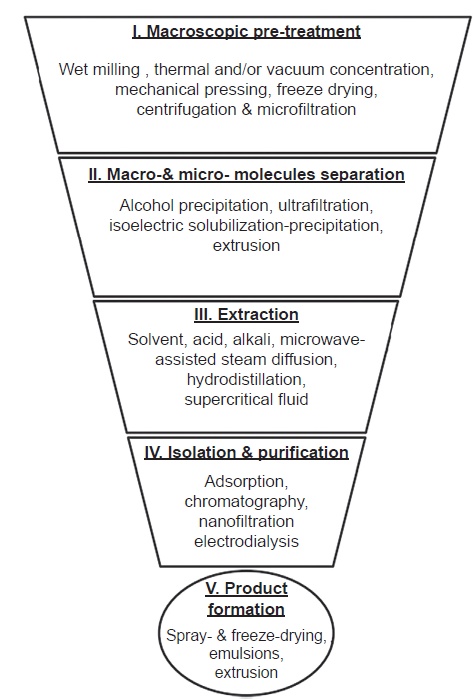
In the agri-food industry, researcher Charis M. Galanakis and his team have been advancing the “5 Phases of the Universal Recovery Process,” developed both in academic settings and through industrial applications in analytical laboratories, technology centres, and related industries.
This sustainable strategy focuses on recovering high-value compounds from agri-food wastewater, such as phosphorus, nitrogen, organic acids, sugars, bioactive compounds, and heavy metals.
-
Macroscopic Pretreatment: Adjusting wastewater properties to prepare it for subsequent phases.
-
Macro- and Micro-Molecule Separation: Isolating target compounds by exploiting differences in physical and chemical properties, such as size, structure, charge, or hydrophobicity.
-
Extraction Process: Concentrating and extracting target compounds from the pre-treated liquid matrix.
-
Purification and Isolation: Removing impurities to obtain high-purity extracts suitable for industrial use.
-
High-Value Product Formation: Stabilising and integrating the recovered compounds into final products for end users.
This process forms a “pyramid” approach to recovering and refining valuable compoundswhether nutrients, bioactives, or metals, while ensuring optimal use of available technologies. It has become a foundational element in circular economy strategies and bio-refinery concepts.
Circular Economy Applications in the Food Industry
Industry players are increasingly committed to integrating circular economy action plan strategies across the value chain, particularly through bio-refinery models and innovative treatment systems for recovering active compounds that can be used in new products or ingredients.
In addition to these examples, advanced techniques such as supercritical CO? extraction are playing an increasingly important role in resource recovery. This method enables selective separation, concentration, and purification of bioactive compounds from complex liquid matrices, without the use of harmful solvents, ensuring both environmental safety and the preservation of functional properties in recovered ingredients.
We continue to develop and validate sustainable nutrient and compound recovery systems for organic aqueous matrices, applying membrane-based physical separation techniques or combining aquatic biomass cultivation (such as microalgae or duckweed) with physical separation technologies.