One in four people takes a nutritional supplement daily or almost daily to improve their quality of life, health, or general wellbeing. Nutraceutical products and dietary supplements from natural sources are on the rise. We will tell you about the encapsulation technologies that are enabling a new generation of products with advanced properties, the so-called “compounds or actives 2.0”, and how you can train to apply these technologies in your company.
The term “nutraceutical” derives from a fusion of the words nutrition and pharmaceutical. Nutraceutical products and dietary supplements go beyond their nutritional value by providing additional health benefits. These products are intended to complement the diet, providing nutrients that may not be consumed in sufficient quantities or with some active functionality.
Their global significance is clear, as
one in four people worldwide takes a nutritional supplement daily or almost daily to improve their quality of life, health, or general wellbeing. Various aspects include:
- Enhancing athletic performance
- Boosting our immunity against diseases
- Combating aging, seeking aesthetic benefits (nutricosmetics)
- Weight loss
Among others, these are the reasons that drive consumers to consume them.
The bioactive compounds in nutraceutical products mostly come from natural sources. Currently, the dominant trend is the use of products obtained through natural biotechnological processes, whether fermentative or enzymatic, and they may contain probiotic microorganisms or their metabolites, vitamins, enzymes, minerals, fatty acids, and/or amino acids of high nutritional value.
Microencapsulation enhances the bioavailability, safety, and biocompatibility of bioactive compounds
Due to their nature, these are often
sensitive compounds, so it is necessary to stabilize them against external degradation factors, as well as ensuring they can exert their biological effect where needed, meaning they must be
bioaccessible, bioavailable, and functional. The use of
microencapsulation technologies and new coating materials for controlled and targeted release of bioactive compounds is a rising trend because they can significantly enhance their bioavailability, safety, and biocompatibility.
In this regard, the various existing
microencapsulation technologies enable the enhancement of advanced properties in ingredients and active substances, such as
protecting sensitive compounds from external
degradation factors (oxidation, moisture, light, pH, etc.), providing
prolonged release over time, selective release under specific conditions, modifying fluid
dynamics properties, masking aromas and flavors, or combining incompatible compounds.
Functional bioactive compounds and molecules in microencapsulated form
Due to the wide array of active substance types, microencapsulation technologies, and encapsulation materials,
most compounds and bioactive molecules with functional properties are commonly presented in microencapsulated form. These particles are obtained through various microencapsulation technologies (physical, chemical, and physicochemical), and each allows for the use of specific types of coating materials to achieve the desired functionality.
New generation of products with advanced properties: “compounds or actives 2.0”
Thanks to these microcapsules, many
bioactive compounds are now offered with
enhanced efficacy, controlled and targeted release properties, improved appearance and flavour, or protected against harsh oxidation or processing conditions, resulting in a new generation of advanced properties products that can be termed “compounds or actives 2.0”. In other words, thanks to these technologies and materials, companies can offer consumers products with new properties, more effective, easier to use, safer, and healthier.
To meet this growing demand, at AINIA we have expanded our offering in microencapsulation technologies, including:
- Biotechnological techniques for targeted capsule generation such as extracellular vesicles.
- Monomodal capsule formation techniques.
Novel natural coating materials, or less aggressive encapsulation techniques.
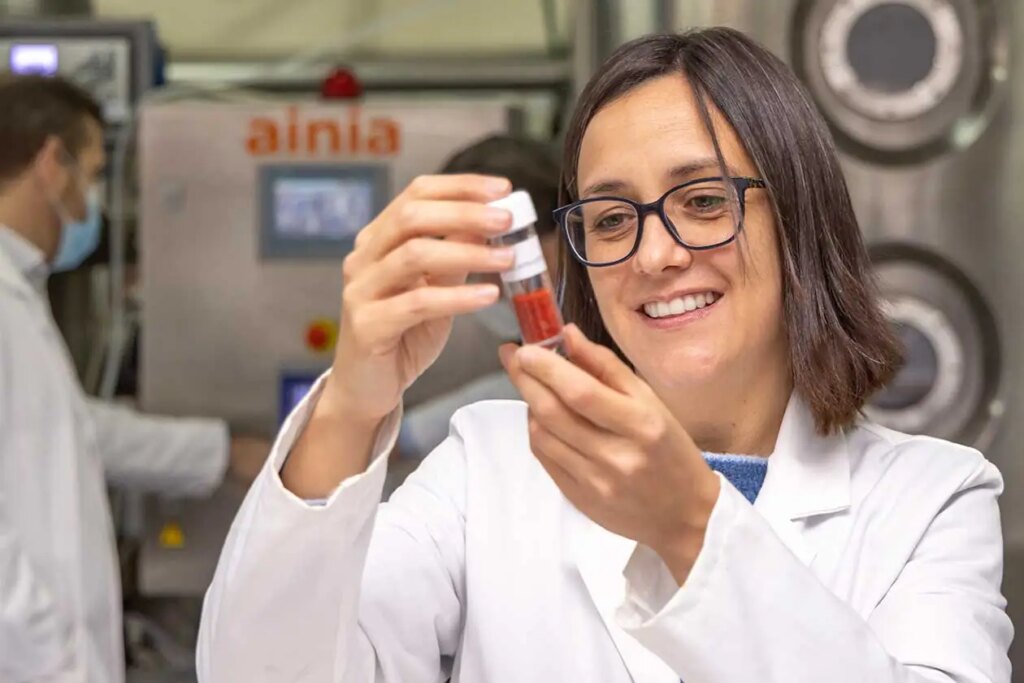 The selection of encapsulation technology along with coating materials, based on the nature of the active ingredient and the desired functionality, are fundamental aspects for the successful development of an encapsulated product
. However, it’s not a straightforward process. All encapsulation technologies and coating materials have limitations: certain compounds may degrade during the process, encapsulation efficiency may not be sufficient, process performance and costs may not be feasible, encapsulation materials may not meet the desired requirements, etc. Therefore, it is necessary to optimize the encapsulation process.